We parked at the trailhead off Machete Trail at 6:42 on a Saturday in October, the kind of small Florida town on Lake Apopka most people drive past on the way to Clermont. A great blue heron stood on the boardwalk rail. The lake sat flat and held the pre-dawn sky. By the time we had the drone up, the first kayak was already out, half a mile north, paddling slow.
The Town of Oakland is a 3,917-resident municipality on the south shore of Lake Apopka in west Orange County, Florida, two miles west of Winter Garden and 18 miles west of downtown Orlando. Incorporated in 1887 as the Orange Belt Railroad headquarters, the town carries a historic Tubb Street grid, the Oakland Nature Preserve on Lake Apopka, the West Orange Trail crossing on the original rail right-of-way, and the new Briley Farm estate community on the lake.
What we noticed
Lake Apopka does the heavy work in any aerial of this town because the lake is the second-largest in Florida and it sits on the entire northern edge. The south-shore drone position pulls cleaner shoreline-to-horizon frames here than anywhere else on the water. The historic Tubb Street grid runs three blocks south of the boardwalk and most of the older wood-frame homes still carry tin roofs and porch detailing from the post-1895 rebuild after the freeze that ended the citrus golden age, per the Town of Oakland history page.
What you do not see from the road is the water-color cycle. October through April the lake reads clean blue from 80 feet up. May through September the algae bloom cycles shift the water to a flat green, which kills a low aerial pass and pushes the photographer toward higher altitudes or different angles. The kayak crowd knows the cycle and shows up accordingly. The morning we shot, the water was the cleanest it had been since April.
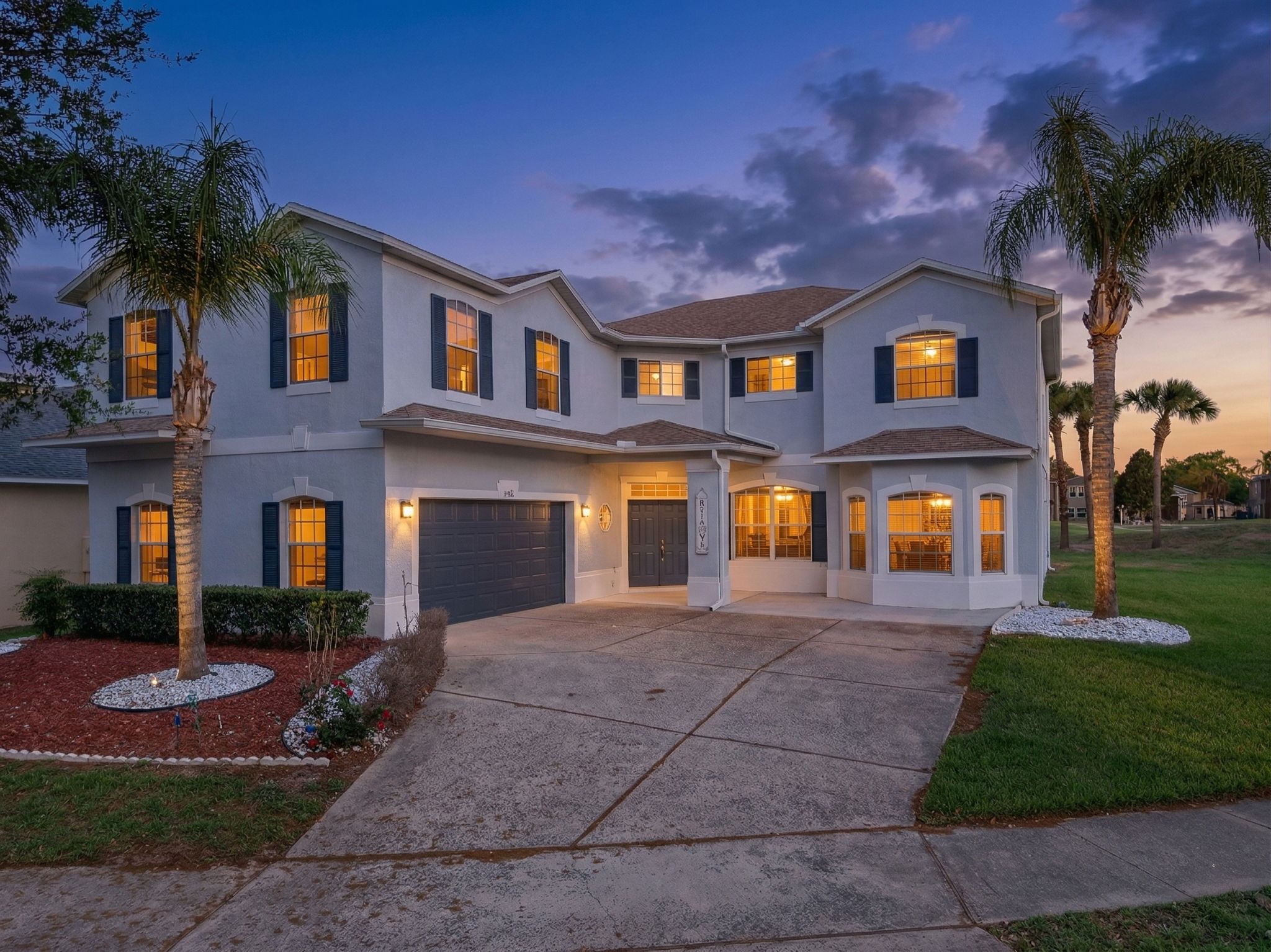
The smaller three-bed off Mather Smith in the residential core is the kind of listing that prices the town's middle slice. It sat with the same square footage as a south-side suburban comp on Bobcat Chase Boulevard, but at $381 per square foot against $331 per square foot per the active Oakland inventory on Zillow, a 15 percent premium for the location closer to the historic core. The Bobcat Chase product is the south-side subdivision pattern that turns over most often. The Mather Smith product is what charter-school families and West Orange Trail walkers actually pay for, and the spread between the two is the entire underwriting story of the town outside the Briley Farm estate pocket.
Town of Oakland 2020 Census population
Source: U.S. Census Bureau profile, Oakland town, Florida
That population number is the buyer-pool reality. With under 4,000 residents and a tight municipal footprint per the U.S. Census Bureau profile, Oakland carries the smallest residential market in the west-Orange corridor. Listings here move slower than Winter Garden or Horizon West because the pool is smaller. The ones that match a specific buyer profile (the Oakland Avenue Charter School families, Lake Apopka shoreline buyers, West Orange Trail walkers) transact reliably. The ones that try to sell on generic west-Orange suburban features have a harder time than they would two miles east.
The photographer's read
Lake Apopka reads cleanest from a south-shore drone position at sunrise, with the east-facing light skimming the water for the first 40 minutes after the sun clears the tree line. The same position at sunset gives west-facing light along the shoreline. Most lake-context aerials should be shot from a position south of the lake looking north. Historic-district homes carry tin roofs and wood siding that read soft on a long lens and crisp on a wide, so a 24mm framing works better for the older stock than the 35mm or 50mm that suits the newer subdivision product south of State Road 50. Briley Farm new-construction listings benefit from a high-altitude lake-context frame more than a low front-elevation frame, because the lake is the differentiator the price point is paying for.
The airspace is friendlier here than most of Orange County. Class G covers most of the town, with the Orlando Class B veil to the east beginning past the Florida Turnpike, per Florida Class B/D drone references. No LAANC overlay is required for typical residential work. The exception is commercial drone work over the Lake Apopka restoration zones managed by the Florida Fish and Wildlife Conservation Commission, which we clear ahead of any flight over the open water. We watch the boardwalk during weekend birding hours.
The drone came down at 7:31, the heron was still on the rail, and the second kayak was 200 yards out. The full read lives at /neighborhoods/oakland.