The short answer
The Town of Oakland is a separate Orange County municipality on the south shore of Lake Apopka in west Orange County, Florida, roughly two miles west of Winter Garden and about 18 miles west of downtown Orlando. Incorporated in 1887 as the headquarters of the Orange Belt Railroad, the town holds a historic downtown grid along Tubb Street, the Oakland Nature Preserve on Lake Apopka, the West Orange Trail crossing on the original rail right-of-way, and the Oakland Avenue Charter School with a 10-out-of-10 GreatSchools rating. ZIP 34760 maps the entire town and a thin slice of unincorporated west Orange County.
Where it actually is
The Town of Oakland is a separate Orange County municipality, not the city of Oakland in California, and not a neighborhood inside Winter Garden. The town sits on the south shore of Lake Apopka, Florida's fourth-largest lake, about 18 miles west of downtown Orlando.
The boundary, in driving terms: Lake Apopka is the northern edge. Johns Lake is the southern edge. The Florida Turnpike is the eastern boundary, and unincorporated west Orange County wraps the west side. State Road 50, called West Colonial Drive locally, runs east to west across the southern half of the town and connects it to Winter Garden (two miles east) and Clermont (eight miles west).
The internal grid is small and historic. Tubb Street runs north to south as the original 1880s town spine. Oakland Avenue runs east to west and crosses Tubb at the historic core. The West Orange Trail crosses through the town on the original Orange Belt Railroad right-of-way, with the Nature Preserve trailhead at 747 Machete Trail as the western anchor inside the town.
ZIP 34760 maps the entire town and a thin band of unincorporated land. The town's ACS 2023 5-year population estimate is 3,566(ACS 2023 5-year estimate).
The photographer's read
Our working notes on shooting in the town. The lake is the central frame, and it sits on the north side of the town. That orientation matters: Lake Apopka reads cleanest from a south-shore drone position at sunrise (east-facing light skimming across tens of thousands of acres of open water) and from the same position at sunset (west-facing light along the historic-district shoreline). Most lake-context aerials should be shot from a position south of the lake looking north.
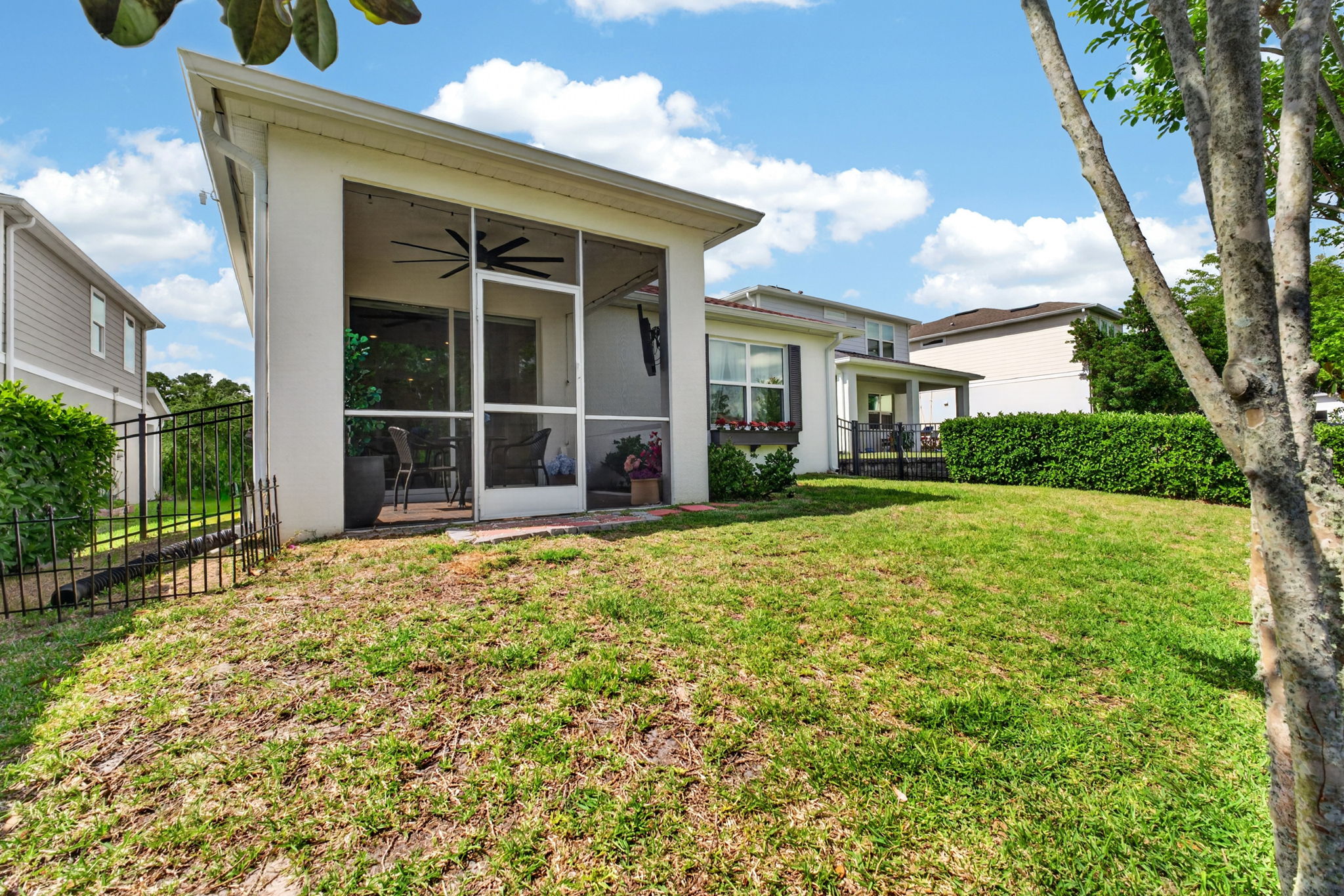
Historic-district homes carry tin-roof and wood-siding details that read soft on a long lens and crisp on a wide angle. Stills work here benefits from a wider 24mm framing than the 35mm or 50mm that works for newer Winter Garden subdivision stock. Briley Farm new-construction listings benefit from a high-altitude lake-context drone frame more than a low front-elevation frame. The lake-context shot is the differentiator for that inventory pocket and the price point it commands.
Seasonal shooting window
Lake Apopka water color is the seasonal variable. October through April the water reads clean blue. May through September the algae bloom cycles can shift the water to dull green, which reads flat from a low aerial position. Plan twilight passes and lake-context drone frames inside the cleaner-color window when possible.
Airspace is friendlier here than in Altamonte Springs or Winter Park. Class G airspace covers most of the town, with the Orlando Class B veil to the east beginning past the Florida Turnpike. No LAANC overlay is required for typical residential work. Commercial drone work over the Lake Apopka restoration zones should clear with the Florida Fish and Wildlife Conservation Commission. We watch the Nature Preserve boardwalk during weekend birding hours and clear lakeside passes with property owners on the Briley Avenue corridor.
The best months for an exterior package here, in order: March, April, October, November, February. The cleaner water color window aligns with the best lake-context shooting season.
What it feels like to drive in
You enter the town from Winter Garden heading west on State Road 50, and the first thing the road does is open up. The retail strip thins. The Florida Turnpike crosses overhead. A few blocks farther west, the original 1880s grid pulls south of SR 50 into the historic core.
Tubb Street is a narrow two-lane through a stand of live oaks and historic wood-frame homes. The Historic Oakland Town Hall at 221 North Tubb Street is the civic anchor. The houses on the blocks south of the town hall include some of the oldest building stock in west Orange County, with tin-roof and wood-siding details that date to the post-1895 rebuild after the fire that destroyed the original commercial district.
Drive north from the town hall on Tubb Street toward Lake Apopka and the canopy thins. The Oakland Nature Preserve trailhead opens onto the south shore. The accessible boardwalk runs through lakefront marshes to the open lake. Lake Apopka is the dominant view here, with the McDonald Canal and the historic farms of the Lake Apopka North Shore visible on a clear morning.
Drive south from Oakland Avenue toward State Road 50 and the town shifts into 1990s and 2000s subdivision product. The blocks around Johns Lake on the south boundary hold most of the town's newer single-family inventory. Briley Farm, the new estate community on the Lake Apopka shoreline, sits in its own pocket west of the historic core off Briley Avenue. The first homes there finished in 2025, with Phase 2 currently building 87 additional estate homesites per the Briley Farm site.
Who lives here
Population and income
The ACS 2023 5-year population estimate for the town is 3,566(ACS 2023 5-year estimate).
The median household income figures vary by data source and geography. The town-level median household income is $142,917(ACS 2023 5-year estimate) per the ACS 2023 5-year estimate. The ZIP-level (34760) median household income is $93,804 per the 2024 ACS-derived ZIP profile. The gap is real: the ZIP boundary catches a wider area than the town limits, including some of the lower-income unincorporated tracts to the south and east, while the town limit catches a higher concentration of the Briley Farm and lakeside estate inventory.
| Geography | Median Household Income | Median Age | Notes | |
|---|---|---|---|---|
| Town of Oakland (town limits, ACS 2023 5-yr) | $142,917 | 40.2 years | Includes Briley Farm and lakeside estate concentration | |
| ZIP 34760 (broader boundary, 2024 ACS-derived) | $93,804 | — | Includes lower-income unincorporated tracts to south and east |
Demographics and buyer profile
The median age is 40.2(ACS 2023 5-year estimate) years. The age curve here skews older than peer west Orange County subdivisions like Stoneybrook West or Hamlin, a function of how much of the local residential stock predates the 2010s family-subdivision wave that built out neighboring Winter Garden.
The racial composition, per World Population Review, is 54.72 percent White, 26.14 percent Black or African American, with smaller Asian and multiracial populations. The poverty rate is 7.21 percent. Owner-occupancy is high at 82.7%(ACS 2023 5-year estimate) per the ACS 2023 5-year estimate. The 17.5 percent of households earning over $200,000 a year per the ZIP profile is the slice driving the recent Briley Farm and lakeside-estate price points.
The buyer pool here is split. Long-tenured local families occupy most of the historic-district housing stock. Newer arrivals are concentrated in the south-side 1990s and 2000s subdivisions and the brand-new Briley Farm pocket. The mix is unusual for west Orange County, where most municipalities are dominated by 2000s and 2010s family-subdivision product.
The town's small population and tight municipal footprint mean that the buyer-and-seller pool is consistently the smallest in west Orange County. Listings move slower because the pool is smaller, but the listings that match a specific buyer profile (charter-school families, Lake Apopka shoreline buyers, West Orange Trail walkers) transact reliably.
Schools
Public schools here are zoned by Orange County Public Schools. The town has one school inside its limits and feeds into Winter Garden schools at the middle and high school levels. The Oakland Avenue Charter School is the town's defining education asset.
Elementary schools
Oakland Avenue Charter School at 456 East Oakland Avenue is the town's K-5 charter school. GreatSchools rates the school 10 out of 10. Enrollment is 531 with a 14-to-1 student-teacher ratio. State test data shows 65 percent of students at or above proficient in math and 65 percent in reading. The school runs an Orton-Gillingham reading model implemented in all K-5 classrooms beginning January 2022, per the Town of Oakland school page. The school's reputation is strong enough that it pulls applications from the broader Winter Garden and Horizon West area.
Tildenville Elementary School at 1221 Brick Road in Winter Garden is the assigned neighborhood elementary for most 34760 addresses that are not enrolled at the charter. GreatSchools rates it 7 out of 10. State test data shows 68 percent math proficiency and 64 percent reading proficiency.
Whispering Oak Elementary School at 15300 Stoneybrook West Parkway is the assigned elementary for some south-side addresses near the Stoneybrook West boundary. GreatSchools rates the school 10 out of 10. 88 percent math proficiency, 84 percent reading proficiency.
Middle and high school
Lakeview Middle School at 1200 West Bay Street in Winter Garden is the assigned middle school for most addresses in the town. GreatSchools rates it 4 out of 10. State test data shows 48 percent math proficiency and 45 percent reading proficiency.
West Orange High School at 1625 Beulah Road in Winter Garden is the assigned high school for nearly all of the town. The school enrolls 2,792 students in grades 9 through 12 with a 25-to-1 student-teacher ratio. It runs AP coursework, 29 sports programs, and a Project Lead The Way engineering curriculum per U.S. News.
A practical note for parents: the Orange County Public Schools attendance boundary is the controlling document, not the town limit or the ZIP. The charter school requires a separate application and lottery. Confirm any school-zone claim with the official OCPS school zone search before relying on listing copy.
| School | Grades | GreatSchools Rating | Math Proficiency | Reading Proficiency | |
|---|---|---|---|---|---|
| Oakland Avenue Charter School | K-5 | 10/10 | 65% | 65% | |
| Tildenville Elementary | K-5 | 7/10 | 68% | 64% | |
| Whispering Oak Elementary | K-5 | 10/10 | 88% | 84% | |
| Lakeview Middle School | 6-8 | 4/10 | 48% | 45% | |
| West Orange High School | 9-12 | — | — | — |
Housing stock
Single-family housing here spans more building eras than the town's population would suggest. The architectural mix, in rough order of historic prevalence: late 19th-century wood-frame and tin-roof historic-district homes (1880s through 1910s, concentrated on Tubb Street and Oakland Avenue), 1990s and 2000s suburban tract product south of State Road 50, limited mid-century stock in the older subdivisions, and the new 2020s estate construction inside Briley Farm on the Lake Apopka shoreline.
The 2024 ZIP-level median home value is $462,500, well above the U.S. median of $332,700. That number reflects the older subdivision baseline; the Briley Farm and lakefront slice runs meaningfully higher.
Briley Farm estate pocket
The Briley Farm community sits in its own pocket on 111 acres of original Briley family land, settled in 1890 per the developer site. The community currently shows two single-family homes for sale with an average list price of $3,285,000 and three lots for sale with an average list price of $1,013,333. Phase 2 will add 87 estate homesites with a minimum 80-foot width, including four lots directly on Lake Apopka. Estate homes are expected to price in the millions.
Lot sizes and inventory
Lot sizes vary sharply by sub-area. Historic-district lots are typically quarter-acre to half-acre. The 1990s and 2000s subdivisions south of SR 50 run smaller, typically 7,000 to 9,000 square feet. The Briley Farm lots run one-third acre to one-plus acre. Inventory on Zillow as of the research date shows 28 active single-family listings citywide in the 34760 ZIP and broader local market.
Owner-occupancy is high at 82.7%(ACS 2023 5-year estimate) and turnover is slow. The historic-district inventory rarely lists. Most market activity is the south-side subdivision product and the brand-new Briley Farm phase.
What's selling now
Three active listings in the area, sampled on the research date, that span the three typical inventory pockets in the town's residential market.
| Address | Price | Beds / Baths | Sqft | Status | |
|---|---|---|---|---|---|
| 2618 Bobcat Chase Boulevard | $519,000 | 3 / 2 | 1,565 | Active | |
| 100 Mather Smith Drive | $598,000 | 3 / 2 | 1,571 | Active | |
| 10 Vandermeer Street | $924,900 | 4 / 4 | 3,838 | Active |
2618 Bobcat Chase Boulevard at $519,000 is the south-side suburban inventory pattern. Three bedrooms, two baths, 1,565 square feet. Price per square foot at $331. This is the typical Johns Lake subdivision product here, the inventory pocket that turns over most frequently in the town's market.
100 Mather Smith Drive at $598,000 is the upper-middle slice of the town's residential core. Three bedrooms, two baths, 1,571 square feet. Price per square foot at $381. The smaller envelope at a higher per-square-foot price reflects the location closer to the historic district and the town center.
10 Vandermeer Street at $924,900 is a larger newer-build single-family. Four bedrooms, four baths, 3,838 square feet. Price per square foot at $241. This is the upper end of the typical 34760 inventory outside the Briley Farm estate pocket, which sits in a separate price tier entirely.
The pattern across the three: the typical subdivision buyer here is paying $240 to $380 per square foot depending on the lot, the school zone, and the proximity to the historic core. The Briley Farm estate slice operates on a different curve entirely, with lakefront product in the $3M-plus range per the community inventory. The split between the two inventory pockets is the defining feature of the local market in 2026.
Where locals actually go
The center of gravity is Oakland Nature Preserve. The 128-acre preserve on the south shore of Lake Apopka holds the accessible boardwalk to the open lake, 3.5 miles of upland trails, and the Jim Thomas Environmental Education Center. Free admission. The preserve is also the western trailhead of the West Orange Trail and a primary site on the Great Florida Birding Trail.
The West Orange Trail crosses the town on the original Orange Belt Railroad right-of-way. The 20.8-mile paved rail-trail runs from here east to Apopka, part of the Florida Coast to Coast Trail system. Local riders and walkers use this trailhead as the western terminus, with the bulk of the route running east through Winter Garden, Killarney, Apopka, and Rock Springs.
Oakland Nature Preserve
128 acres on Lake Apopka. Accessible boardwalk to the lake, 3.5 miles of upland trails, the western trailhead of the West Orange Trail.
Historic Oakland Town Hall
Restored 1880s civic anchor at the historic-district center. Town meetings and community gatherings.
West Orange Trail (Oakland trailhead)
Western anchor of the 20.8-mile paved rail-trail. The original Orange Belt Railroad path, now part of the Coast to Coast Trail.
The Historic Oakland Town Hall on Tubb Street is the civic anchor and the recurring site for town meetings, election polling, and community gatherings. The building sits inside the original 1880s grid and is the most photographed structure in the town outside the lake itself.
Speer Park at Tubb Street and Petris Avenue is the town-center park inside the historic downtown grid. The town's history page tracks the full timeline from the 1886 Orange Belt Railroad through the 1887 incorporation and the 1895 freeze that ended the citrus golden age.
Lake Apopka itself is the largest lifestyle anchor and the largest single visual feature. The lake is in a multi-decade restoration after the 1990s farm-buyout closures, with the Lake Apopka North Shore wildlife drive and birding hotspot on the opposite shore. This side of the lake holds the cleanest south-shore access points in the entire west-Orange region.
Selected ASM work
Browse selected, permissioned work in the ASM portfolio.
If you are working a listing here and the address is inside the 34760 boundary, the package we default to is a stills plus drone exterior package with optional twilight, 3D tour, and a Lake Apopka context aerial. We are FAA Part 107 certified for the drone work and Zillow Showcase certified for the Showcase listing tier. Coverage runs across Orange, Seminole, Lake, Osceola, Polk, Hillsborough, Brevard, and Volusia counties.
For a 34760 single-family scope, the most common add-on agents request is a Lake Apopka context drone frame, which is the visual signature of the town. The second is a West Orange Trail crossing shot for listings within walking distance of the trail. The third is a Briley Farm community lifestyle b-roll segment for listings inside that pocket, which sits in a separate price tier from the surrounding 34760 inventory.